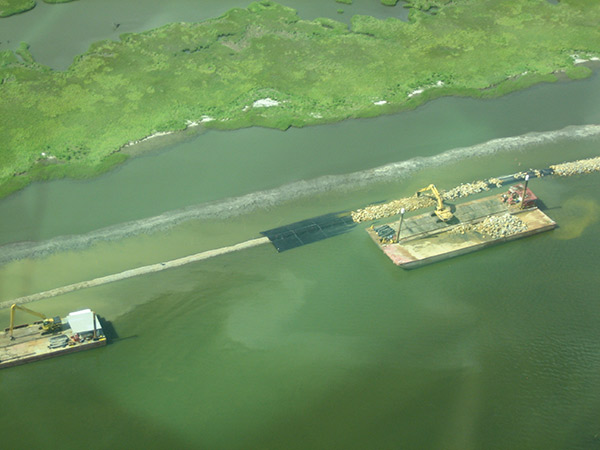
Installation of a foreshore rock dike to prevent the coalescence of Lake Borgne with the MRGO.
The MRGO was a 36-foot deep, 500-foot wide, 76-mile long navigation channel from the Gulf of Mexico to the city of New Orleans. Despite initial widespread federal, state, and local support for its construction, the MRGO had become controversial, and was deauthorized and closed in 2008. Wave wash from deep-draft navigation had been eroding the MRGO channel by up to 35 feet per year, and the Lake Borgne shoreline was eroding at an average rate of 10-15 feet per year, threatening to breach the land bridge separating these two water bodies.
BEM Systems, Inc. (BEM) led the preparation of an Environmental Impact Statement (EIS) for the Mississippi River-Gulf Outlet (MRGO), Louisiana, and Lake Borgne – Wetland Creation and Shoreline Protection project for the U.S. Army Corps of Engineers (USACE), New Orleans District, to analyze the effects of proposed restoration efforts on significant ecological and economic resources. The restoration project was funded by the Third Supplemental Appropriations Act (P.L. 109-148) passed in response to Hurricane Katrina.
The goal of the selected plan was to protect and restore wetlands and other coastal features within the estuaries located east and southeast of New Orleans that were damaged by Hurricanes Katrina and Rita in 2005. The implementation of the proposed restoration efforts was necessary to prevent the continued loss of wetlands and to re-establish natural areas of marsh for storm surge protection. The proposed action would create and nourish 3,345 acres of brackish and saline wetlands, and included the installation of 13.7 miles of foreshore rock dike shoreline protection on the land bridge separating Lake Borgne from the MRGO.
In addition to researching and drafting many of the biological and socioeconomic sections of the EIS, BEM staff worked with the USACE and USFWS to develop the benefits analysis plan alternatives, using the Wetlands Value Assessment (WVA) protocol developed for the Coastal Wetlands Planning, Protection and Restoration Act (CWPPRA). Tasks included developing the description of the proposed action area (DOPAA), the formulation of measures and alternatives, documenting the “future with project” and “future without project” feature impacts and the evaluation of environmental consequences on important resources. BEM also developed the draft Coastal Zone Management Act consistency report, and documented the Biological Assessment, which was used to obtain the Biological Opinion on Gulf sturgeon from NOAA Fisheries.